01
Team and roles
Six ways of organizing email production, and where decisions are made.
Page 4
Better Email Research · November 2026
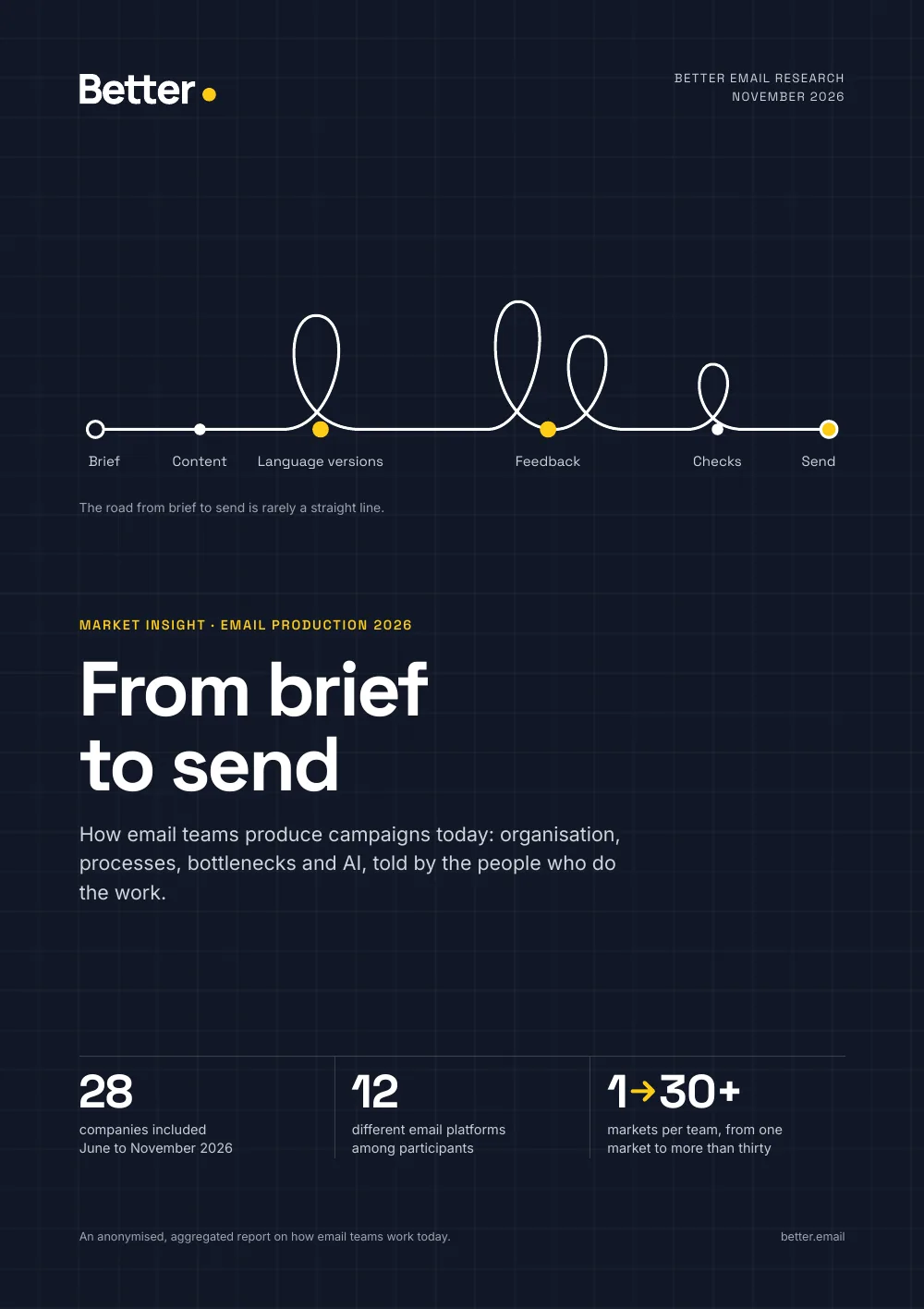
How email teams produce campaigns today: organization, processes, bottlenecks and AI, told by the people who do the work.
We spoke with email, CRM and marketing leads at 28 companies, from teams of three to central teams covering more than 30 markets. The 12-page report shows where their time goes and which practices worked for them.
In short
The range is wide: from teams of three people to large central teams, and from handling one market to more than thirty. Even so, the patterns were strikingly similar.
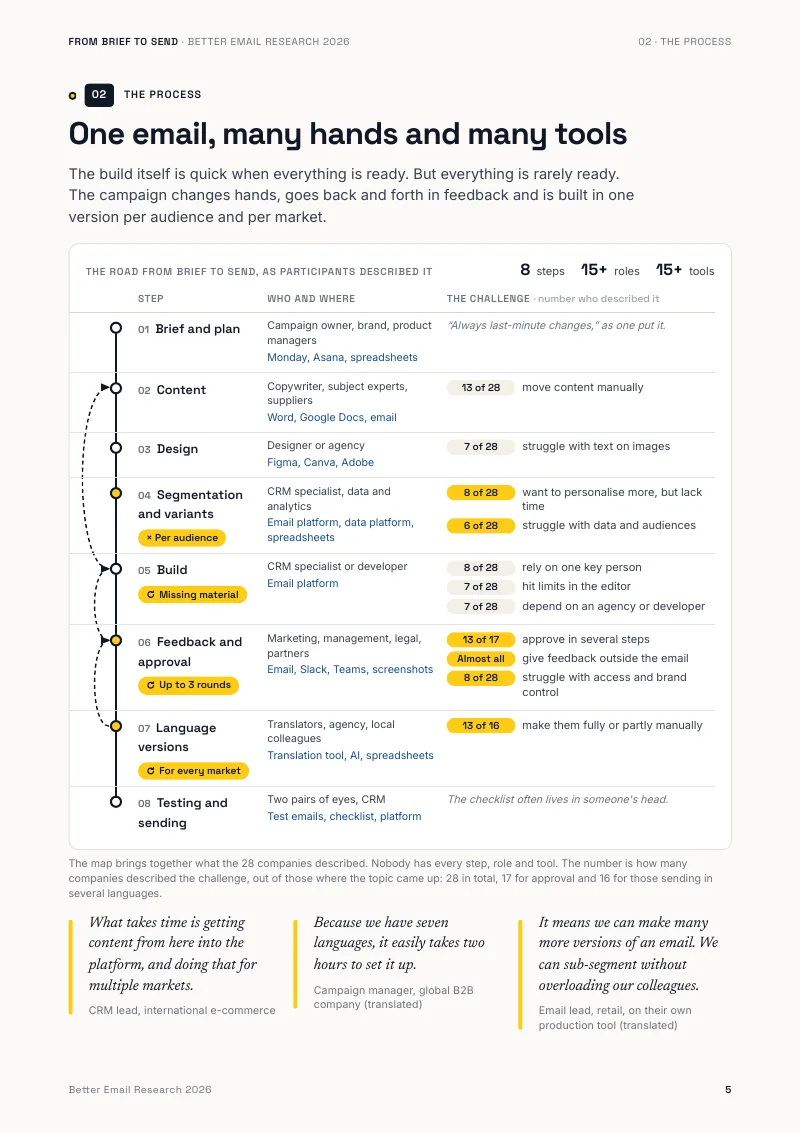
Copy, images and links are moved from spreadsheets, documents, Figma and translation tools into the email platform. The templates are rarely the problem. It’s the moving that eats the time.
Almost everyone who sends in several languages makes the versions fully or partly manually. New and smaller markets get fewer versions, and for one team this holds back growth.
Most approve in several steps. Almost nobody gives feedback directly on the email itself. It lives in emails, Teams, Slack, PDFs, screenshots, Figma or tickets.
Eight of the 28 told us themselves that one key person or a very small team is the bottleneck. Not everyone was asked directly, so this is a minimum. Seven depend on an agency or an external developer when templates or code need to change.
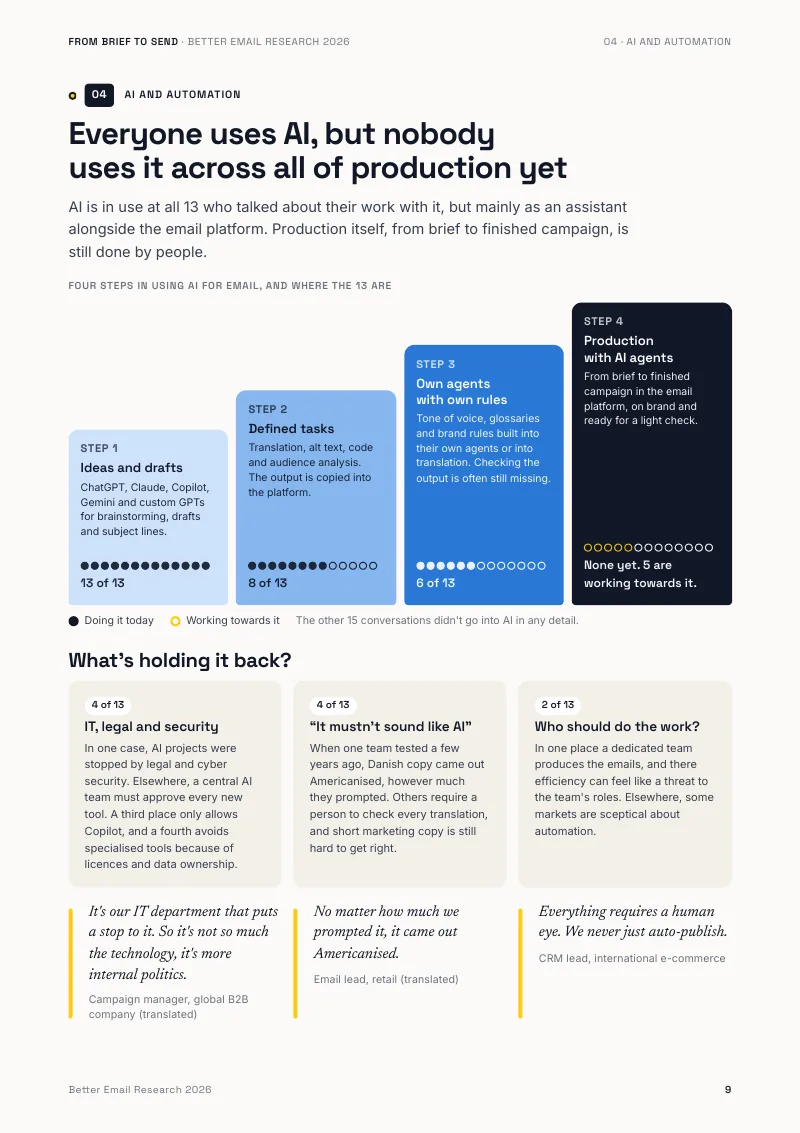
Everyone who talked about AI uses it today, mostly in general-purpose tools, with the output copied into the platform. Nobody yet produces campaigns from brief to send with AI. IT, legal and language requirements are holding it back.
Nine are in the middle of, or have just completed, a switch of email platform. Templates are often moved one to one, and the way they produce stays the same.
Sometimes you’re so happy after a networking event, because you think: how great that it’s not just us struggling with this. Or feeling that we’re light years behind on technology.
Inside the report
Every conversation covered the same four themes. The report sorts what we heard by theme, with the numbers and quotes behind each pattern.
01
Six ways of organizing email production, and where decisions are made.
Page 4
02
Who and what a campaign passes through, and where it gets stuck.
Page 5
03
Language versions, approvals, access, platform and quality.
Pages 6-8
04
What AI is used for today, and what is holding it back.
Pages 9-10
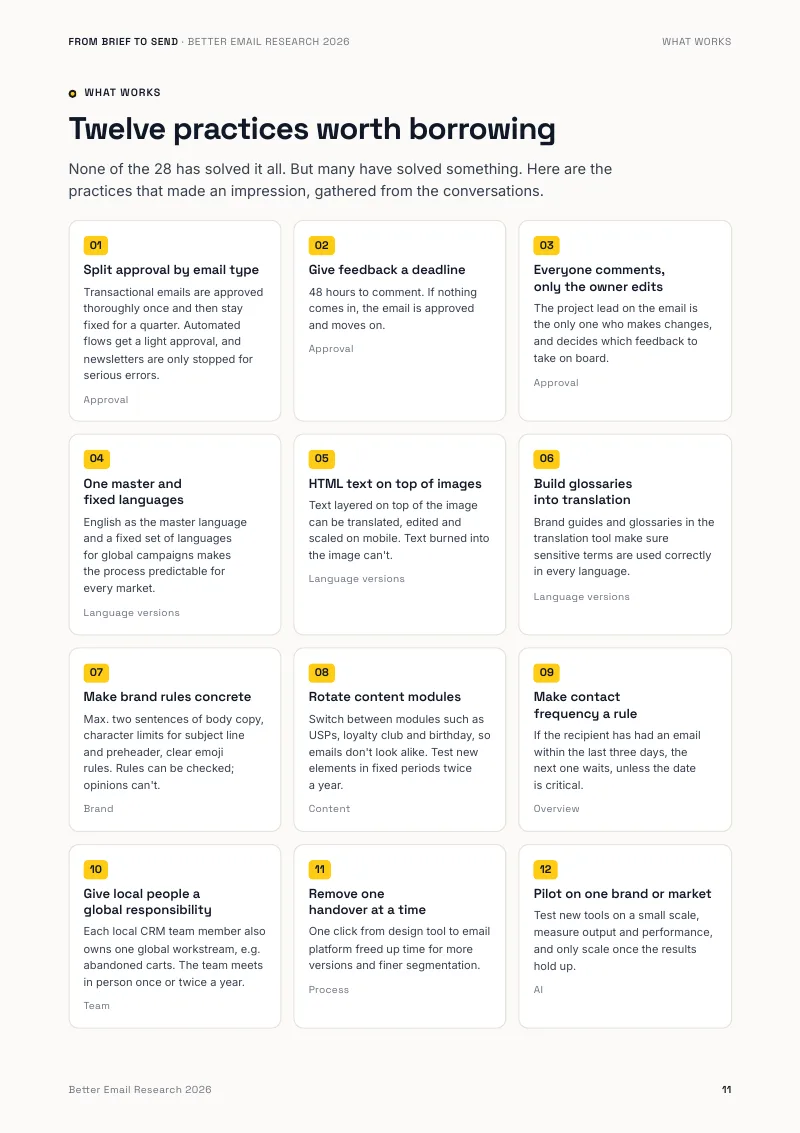
None of the 28 has solved it all. But many have solved something.
There are no right answers. But the answers quickly show where your time goes.
About the study
The report compares ways of working. It is not an audit of campaigns, open rates or conversions, and there is no answer key: very different setups work well for the companies that have them.
Between June and November 2026 we spoke with email, CRM and marketing leads at 28 companies, online or by phone, some over several meetings. We spoke with email and CRM leads, campaign and automation specialists, marketing managers and martech leads.
One last thing
One of the things that came up most in the conversations was a feeling. Many described feeling behind. Even those who, in our view, are well ahead.
Sometimes I feel we’re quite far ahead. And then I talk to someone else and think: oh my god, I don’t know anything.